You will hear this pitch from sales agents all over Cairo: buy now, because prices only go up. Then a friend tells you the opposite: wait, because thousands of units are about to be handed over and prices will have to fall. If you are trying to decide whether to buy property in Egypt now or wait, neither claim tells you enough to decide.
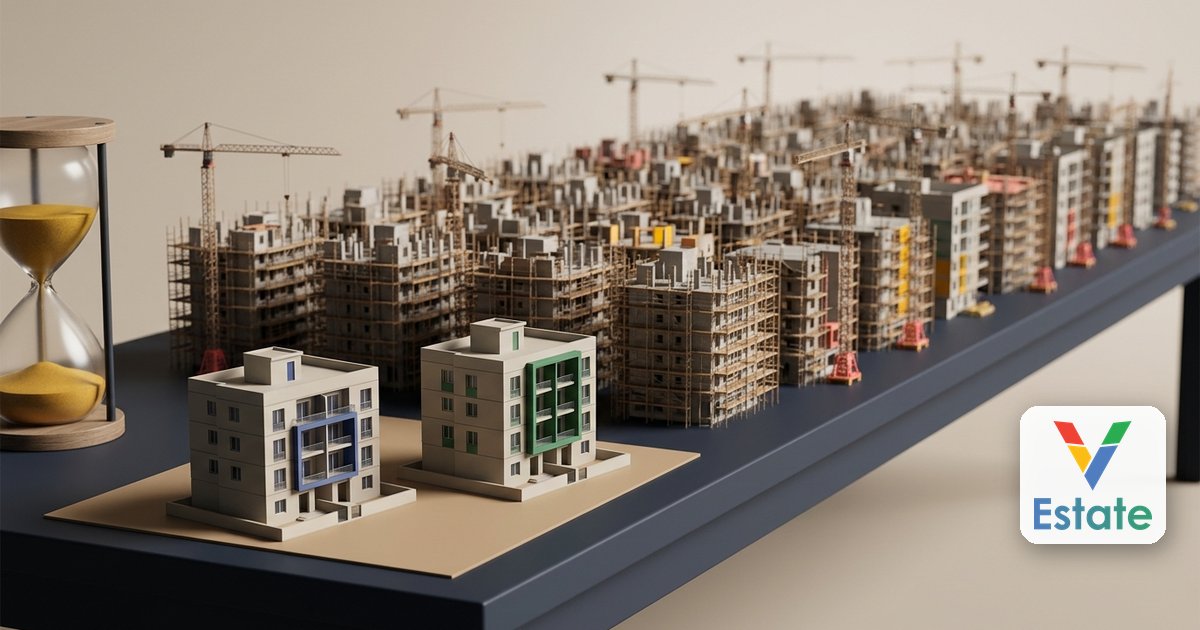
The data shows a real gap. Developers have scheduled relatively few projects to finish in 2026 and 2027, and a much bigger wave in 2028, 2029 and 2030. That gap affects ready homes, off-plan units, resale prices and rents in different ways.
This article shows what the delivery numbers say, where they disagree, and who gains by buying in 2027 versus waiting for the wave.
Short answer: Developer schedules show far fewer projects due in 2026 and 2027 than in 2028 to 2030, though scheduled dates are not guaranteed handovers. That gap supports prices of ready homes now. If you need a home to live in soon, waiting gains little. If you want an investment unit, the late-decade wave of handovers and resales may give you better prices.
What is the 2028 supply wave?
The idea comes mainly from Knight Frank, an international property consultancy. In September 2025 its head of Egypt said the firm was tracking 104 Greater Cairo projects slated for completion in 2028 and 2029, against just 8 a year expected in 2026 and 2027. Knight Frank said the gap "could place upward pressure on prices over the medium term", and repeated the same numbers in its Africa Report in May 2026.
The numbers move between Knight Frank's own publications, though:
| Knight Frank publication | Gap years | Wave years |
|---|---|---|
| Cairo residential review, May 2025 | about 18 projects a year, 2025–2027 | 67 projects in 2028 |
| Destination Egypt 2025 report (full PDF) | 25 projects a year, 2026–2027 | 111 projects in 2028–2029 |
| Press release, 30 September 2025, and Africa Report 2026/27 | 8 projects a year, 2026–2027 | 104 projects in 2028–2029 |
Knight Frank counted Greater Cairo projects with developer units on sale when its 2025 research was compiled, and it notes the true number "could be higher" once later phases are included. So don't quote "8 versus 104" as a precise fact. The direction is consistent across every version: a thin pipeline now and a thick one later.
A second source points the same way. The Q3 2026 Property Intelligence report from KW Egypt and Gateway Financials counts residential projects with a listed delivery date: 94 in 2026, 70 in 2027, 101 in 2028, 153 in 2029 and 207 in 2030. The report itself warns that "these dates do not measure delivery track records". For the sales side of the same report, see what nine-month sales tell brokers.
Why don't delivery dates mean homes will arrive on time?
A listed delivery date is a promise in a brochure. In 2026, late handovers became a national issue. Ahram Online described developers' delays as having "sparked a crisis" in the middle of the year. In August a presidential directive set up a committee to inspect property developments nationwide, and the Housing Ministry later handed one stalled North Coast project, Jefaira, to other developers.
Officials describe the problem as limited. The housing minister said in September that cases of non-delivery "remain minimal", and nobody has published a count of delayed projects.
The money side explains the risk. Developers finance construction from buyers' instalments over 7, 10 and sometimes 12 years. HC Securities' Mariam Saadani told Enterprise that collections "often don't reach 50% by year four", while cement prices rose 26% year on year by mid-2026 according to CAPMAS figures carried by Enterprise. A developer that collects slowly while costs rise is more likely to run late.
Our judgement: the 2028–2030 wave will probably arrive spread out, not all at once. Some projects will slip into 2031 and beyond. Our article on the draft developers' law covers the escrow accounts and buyer funds the government wants to add.
What does the gap mean for ready homes in 2027?
If you plan to buy a home to move into or rent out in 2027, the pipeline works against you. Fewer new projects finishing means existing ready units and near-delivery resales face less competition.
Rents show the pressure. JLL figures reported by Enterprise show asking rents up 11.2% in 6th of October and 10.0% in New Cairo year on year in the first quarter of 2026, as more people rented instead of buying. In the second quarter, rents rose about 7% year on year in both areas.
Sale prices are calmer. JLL measured sale prices up 2.8% in 6th of October and 2.4% in New Cairo over the second quarter, and said prices had "entered a saturation phase". Developers insist prices will not fall. TMG's chief executive said in February that "the price of a ready-made unit won't decrease", pointing to cement and steel costs.
For a buyer who needs a home, our reading is simple: waiting two years for the wave means two more years of rent, with no published forecast that ready-home prices will drop. The rental market picture shows what you would pay meanwhile.
What could the wave do to resale prices and rents after 2028?
We found no named research firm that has published a forecast that the late-decade wave will soften prices or rents. What follows is our reasoning from the data, and it should be read that way.
Many off-plan buyers in Egypt are investors. When a large number of units in the same district are handed over within a year or two, many owners will want to rent them out or sell them at the same time. That is when you would expect more resale listings, longer selling times and more room to negotiate, especially in districts with the heaviest schedules.
The KW Egypt report shows where 2030–2031 handovers are concentrated, as a share of advertised listings:
| District | Share of listings with 2030–2031 delivery |
|---|---|
| Mostakbal City | 48% |
| New Capital | 44% |
| North Coast | 42% |
| October and Zayed | 40% |
| New Cairo | 34% |
The resale market already shows sellers under pressure, though that is not yet an effect of future handovers. Mahmoud Ammar, founder of the contract-resale platform Aqar Exit, told Ahram Online in September 2026 that in some cases sellers accept discounts of 25% to 35% below developers' current launch prices. Aqar Exit's own data shows 20.7% of sellers reporting overdue instalments. The same platform's September index put estimated market values about 35% above original contract values, so a unit can sell below today's launch price and still above its old contract price. Developers, as Saadani put it, "cannot reduce nominal prices", so the discount happens in resale instead. Our explainer on how Aqar Exit and contract assignment work covers fees and rules.
Should you buy in 2027 or wait? A decision table
This table is our judgement based on the figures above. It isn't a promise about prices, and your own numbers and timeline come first.
| Your situation | Lean towards | Why |
|---|---|---|
| You need a home to live in within two years | Buy a ready or near-delivery unit in 2027 | Few new completions before 2028; rents rose through 2026 |
| You want rental income soon | Buy ready, in an established area | A delivered unit earns rent now; a 2030 unit earns nothing for years |
| You want a long-term investment and can wait | Watch the resale market into 2028–2029 | Clustered handovers may bring more sellers and more room to negotiate |
| You are tempted by a 2030 launch with a 12-year plan | Check the developer first, or wait | Far-off dates and slow collections raise the risk of delay |
| You can pay a large share in cash | Look at contract resales now | Stretched sellers already accept discounts to current launch prices |
| You hold money in the bank and are unsure | Compare with the certificate first | See bank certificate or apartment in 2027 |
What should you check before signing for a 2028–2030 delivery?
If you do buy off-plan in 2027, protect yourself on the delivery date:
- The developer's record. Ask which earlier phases were delivered, and how late. Visit one if you can.
- Construction status today. A 2029 date on a site with no structure is a different risk from one with finished buildings.
- The delay terms in your contract. Prime Minister's Decision 2184 of 2022 gives developers a 12-month grace period after the contractual date; beyond 24 months, buyers may defer instalments or seek a refund, subject to the decision's conditions.
- Exit terms. What the developer charges to assign your contract, and whether it allows assignment before delivery at all.
- Your district's schedule. If a large share of your district's projects hand over in the same year as yours, expect competition when you rent or sell.
If you are buying in East Cairo, our New Cairo buyer's guide covers compound checks in more detail. Buying from abroad? Read the 2027 guide for foreign and Gulf investors.
The one number to find before you decide
Pick the district you are considering and ask two developers' sales teams the same question: how many units in this district are due for handover in the same year as your unit? If the answer is "a lot", you are buying into the wave. Price that in, or keep watching the resale listings until the handovers start.
Sources
- Zawya, 30 September 2025: Knight Frank, USD 1.4bln of private capital targets Egypt's residential market as demand surges
- Knight Frank, September 2025: Destination Egypt 2025 (PDF)
- Knight Frank, 18 May 2025: Cairo residential market review 2025
- Knight Frank, May 2026: The Africa Report 2026/27 (PDF)
- KW Egypt and Gateway Financials, 3 November 2026: Egypt Q3 2026 Property Intelligence (PDF)
- Ahram Online, 20 October 2026: report on developer delays and new rules
- Ahram Online, 10 August 2026: Presidential directive to inspect property developments
- Daily News Egypt, 15 September 2026: Egyptian PM reviews draft real estate regulation law to address stalled projects
- Enterprise, 20 September 2026: Housing Ministry hands Jefaira project to new developers
- Daily News Egypt, 16 August 2026: Delivery delays and buyer protection under PM Decision 2184 of 2022
- Enterprise, 16 November 2026: Developers finding it harder to fund construction through long instalment plans
- Enterprise, 22 July 2026: Real estate price gains are masking a liquidity crunch for developers
- Enterprise, 10 November 2026: With rates up, who carries the property market's 10-year payment plans?
- Enterprise, 13 May 2026: Cairo's rental market running double-digit increases while sales stall (JLL Q1 2026)
- Invest-Gate, 19 August 2026: JLL Q2 2026 Cairo residential figures
- Ahram Online, 1 February 2026: TMG's Hisham Talaat Moustafa on ready-unit prices
- Ahram Online, 15 September 2026: Aqar Exit and the resale market
- Daily News Egypt, 6 September 2026: Aqar Exit units reach EGP 72.2bn in estimated market value
- Enterprise, 12 November 2026: Why Cairo's resale property market struggles to compete with developers' payment plans