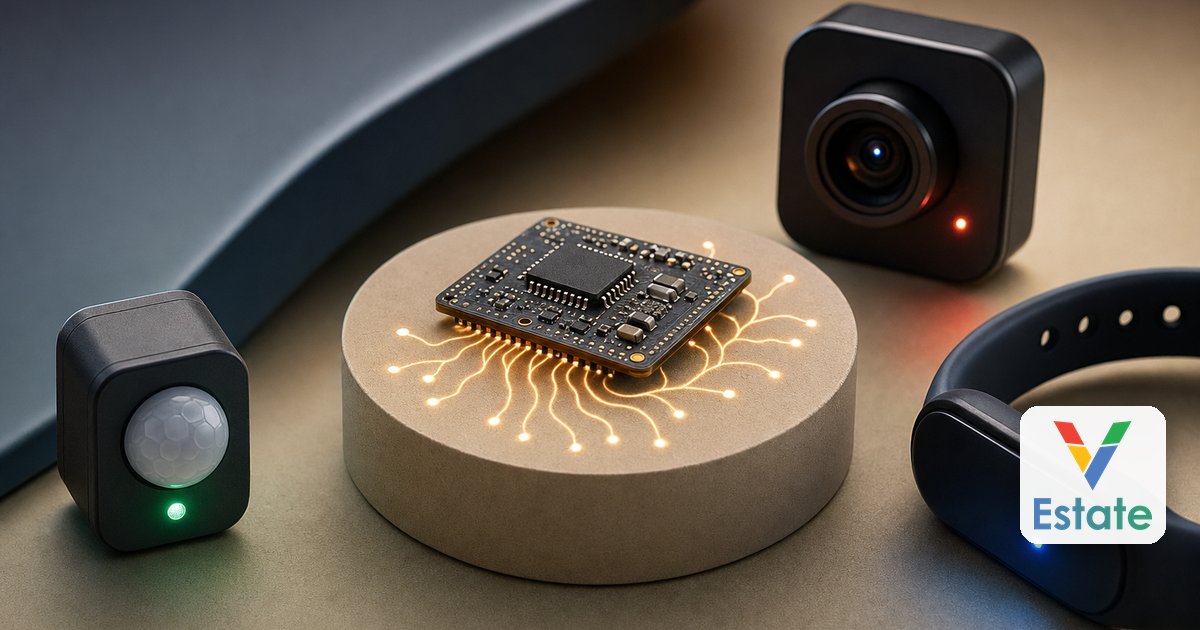
The future of AI isn't just in massive data centers. It's everywhere. In 2026, Edge AI and Tiny Machine Learning (TinyML) are revolutionizing how we deploy intelligence, moving processing from the cloud to billions of edge devices, from smartphones to industrial sensors.
The Edge AI Revolution
Edge AI represents a fundamental shift in where computation happens:
What is Edge AI?
Edge AI brings machine learning models directly to devices, enabling:
- Real-time processing without cloud latency
- Enhanced privacy by keeping data on-device
- Reduced bandwidth requirements
- Offline operation independent of connectivity
- Lower operational costs by reducing cloud dependencies
The TinyML Breakthrough
TinyML takes this further, running ML models on microcontrollers with:
- Ultra-low power consumption (often microwatts)
- Minimal memory footprint (kilobytes, not gigabytes)
- Cost-effective deployment ($1-5 per device)
- Massive scalability to billions of devices
- Always-on intelligence without draining batteries
Market Momentum
The numbers tell a compelling story:
- $90 billion Edge AI market projected by 2027
- 2.5 billion TinyML devices shipped in 2026
- 70% reduction in inference costs vs cloud
- 10-100x lower latency compared to cloud processing
- 95% less bandwidth consumption for IoT applications
Real-World Applications Transforming Industries
Smart Manufacturing
Factories are deploying edge AI for:
- Predictive maintenance: Detecting equipment failures before they occur
- Quality control: Real-time defect detection on production lines
- Worker safety: Monitoring hazardous conditions instantly
- Energy optimization: Adjusting power consumption dynamically
Example: A semiconductor manufacturer deployed TinyML sensors across 500 machines, detecting anomalies 48 hours before failure, reducing downtime by 35% and saving $4.2M annually.
Healthcare & Medical Devices
Edge AI is revolutionizing patient care:
- Continuous monitoring: Wearables detecting cardiac anomalies in real-time
- Early detection: Analyzing vital signs for early disease warning
- Privacy-preserving diagnostics: Processing sensitive data on-device
- Emergency response: Instant alerts for critical conditions
Impact: Smart medical devices with TinyML can now detect atrial fibrillation with 97% accuracy, alerting patients and physicians immediately without sending data to the cloud.
Retail & Consumer Electronics
Enhancing customer experiences through:
- Smart cameras: Instant product recognition and inventory tracking
- Voice assistants: Wake word detection using minimal power
- Personalization: On-device recommendation without privacy concerns
- Contactless payments: Secure, instant transaction processing
Agriculture & Environmental Monitoring
Transforming farming and conservation:
- Precision agriculture: Soil moisture and crop health monitoring
- Wildlife tracking: Conservation efforts with minimal environmental impact
- Climate monitoring: Distributed sensor networks in remote locations
- Water quality: Real-time pollution detection in water systems
Success story: A vineyard deployed 2,000 TinyML soil sensors, optimizing irrigation and reducing water usage by 40% while improving grape quality.
Automotive & Transportation
Driving the future of mobility:
- Advanced driver assistance: Real-time object detection and collision avoidance
- Fleet management: Vehicle health monitoring and predictive maintenance
- Smart traffic systems: Optimizing traffic flow at intersections
- Autonomous vehicles: Processing sensor data with minimal latency
The Technology Stack
Hardware Innovations
Modern edge AI devices leverage:
- Neural Processing Units (NPUs): Dedicated ML accelerators in chips
- RISC-V processors: Open-source architectures optimized for AI
- Low-power AI chips: ARM Cortex-M series, ESP32, Nordic nRF
- Specialized sensors: MEMS with built-in intelligence
Leading platforms: Google Coral, NVIDIA Jetson Nano, Arduino Nano 33 BLE Sense, Raspberry Pi AI Kit
Software & Frameworks
Developers use optimized tools:
- TensorFlow Lite: Optimized for mobile and embedded devices
- Edge Impulse: End-to-end platform for TinyML development
- ONNX Runtime: Cross-platform inference acceleration
- Apache TVM: Compiler stack for deep learning systems
- PyTorch Mobile: Facebook's mobile deployment framework
Model Optimization Techniques
Making models tiny and efficient:
- Quantization: Reducing precision from 32-bit to 8-bit or lower
- Pruning: Removing unnecessary neural network connections
- Knowledge distillation: Training smaller models from larger ones
- Neural architecture search: Automatically finding efficient architectures
Results: A 100MB model can be compressed to 1-5MB with <2% accuracy loss, enabling deployment on constrained devices.
Overcoming Technical Challenges
Power Consumption
Battery-powered devices require extreme efficiency:
- Event-driven processing: Only activate when detecting specific patterns
- Duty cycling: Alternating between sleep and active modes
- Energy harvesting: Using solar, thermal, or kinetic energy
- Adaptive sampling: Adjusting data collection frequency dynamically
Memory Constraints
Working within tight memory budgets:
- Streaming architectures: Processing data in chunks
- In-place operations: Minimizing memory allocation
- Model partitioning: Splitting models across device and cloud
- Compression algorithms: Efficient data storage and transmission
Accuracy vs Efficiency Tradeoffs
Balancing performance with constraints:
- Hybrid approaches: Complex processing in cloud, simple on-device
- Ensemble methods: Combining multiple lightweight models
- Continuous learning: Updating models based on local data
- Federated learning: Training models across distributed devices
Privacy & Security Advantages
Edge AI offers compelling privacy benefits:
Data Privacy
- Local processing: Sensitive data never leaves the device
- Compliance: Easier GDPR, HIPAA, CCPA adherence
- User control: Individuals own their data
- Reduced breach risk: No centralized data honeypots
Security Considerations
But new security challenges emerge:
- Physical tampering: Devices can be accessed directly
- Model extraction: Risk of IP theft through reverse engineering
- Adversarial attacks: Fooling models with crafted inputs
- Firmware security: Ensuring trusted updates
Best practices: Hardware security modules (HSMs), secure boot, encrypted models, and regular security audits are essential.
Business Impact & ROI
Organizations deploying edge AI report:
Cost Savings
- 70% reduction in cloud computing costs
- 60% decrease in bandwidth expenses
- 50% lower total cost of ownership over 3 years
Performance Improvements
- 10-100x faster response times
- 99.9% uptime even during connectivity issues
- 90% reduction in false positives for detection systems
Operational Benefits
- Scalability: Deploy to millions of devices economically
- Resilience: Systems work offline and during outages
- Sustainability: Lower energy consumption and carbon footprint
Industry Standards & Ecosystem
The edge AI ecosystem is maturing:
Standards Development
- ONNX: Interoperable AI model format
- MLOps: Standardized deployment and monitoring practices
- IEEE P2933: Standard for Clinical IoT Data and Device Interoperability
Developer Communities
- TinyML Foundation: Advancing ultra-low power ML
- Edge AI & Vision Alliance: Industry collaboration
- MLCommons: Benchmarking and best practices
Chip Manufacturers
Major players investing heavily:
- Google (Coral TPUs)
- NVIDIA (Jetson)
- Apple (Neural Engine)
- Qualcomm (Hexagon DSPs)
- ARM (Ethos NPUs)
Implementation Best Practices
Start with the Right Use Case
Ideal applications for edge AI:
- High-frequency data: Continuous sensor streams
- Privacy-sensitive: Healthcare, finance, personal devices
- Latency-critical: Safety systems, real-time control
- Connectivity-challenged: Remote locations, mobile devices
- Scale requirements: Millions of deployment points
Design for Constraints
Plan for edge limitations:
- Model selection: Choose architectures designed for efficiency
- Data pipelines: Optimize preprocessing and postprocessing
- Update strategy: Enable over-the-air model updates
- Fallback mechanisms: Handle edge cases gracefully
Monitor and Iterate
Edge AI requires ongoing management:
- Performance tracking: Monitor accuracy and latency
- Drift detection: Identify when models degrade
- A/B testing: Compare model versions in production
- Feedback loops: Collect data to improve models
The Future: 2027 and Beyond
Emerging trends to watch:
Neuromorphic Computing
Brain-inspired chips offering:
- 1000x energy efficiency vs traditional processors
- Real-time learning without retraining
- Pattern recognition at unprecedented scales
On-Device Training
Moving beyond inference to edge learning:
- Personalization: Models adapt to individual users
- Continual learning: Improving from local experiences
- Privacy preservation: Training without data sharing
Edge-Cloud Collaboration
Hybrid architectures combining:
- Edge preprocessing: Filter and aggregate locally
- Cloud intelligence: Complex analysis when needed
- Dynamic workload distribution: Optimize based on conditions
5G & 6G Integration
Next-gen connectivity enabling:
- Ultra-reliable low latency: Sub-millisecond communication
- Network slicing: Guaranteed bandwidth for critical apps
- Massive IoT: Supporting millions of devices per square kilometer
How Vilartech Leverages Edge AI
At Vilartech, we're integrating edge capabilities into our solutions:
Mobile Applications
Our mobile apps use on-device ML for:
- Instant feature recognition
- Privacy-preserving analytics
- Offline-first functionality
- Personalized user experiences
IoT Solutions
Edge AI powers our connected systems:
- Real-time anomaly detection
- Predictive maintenance
- Energy optimization
- Security and access control
Hybrid Architectures
We design systems that intelligently balance:
- Edge processing for real-time needs
- Cloud analytics for deep insights
- Seamless synchronization
- Cost-effective scalability
Getting Started with Edge AI
To begin your edge AI journey:
- Assess your use case: Identify latency, privacy, or cost drivers
- Choose your platform: Select hardware matching your constraints
- Start simple: Deploy proven models before custom development
- Measure everything: Track performance, cost, and user impact
- Iterate and scale: Learn from pilots before wide deployment
Key Takeaways
Edge AI and TinyML represent a fundamental shift:
- Intelligence is distributed, not centralized
- Privacy and performance improve simultaneously
- Billions of devices can now run ML models
- New applications become economically viable
- The edge complements the cloud, not replaces it
The question isn't whether to adopt edge AI. It's how quickly you can integrate it into your products and operations.
Ready to explore edge AI for your applications? Contact Vilartech to discuss how distributed intelligence can transform your business.